Sunday, 22 November 2009

Watch Me If You Can!


I lived through the infamous move of 'The X-Files' from BBC2 to BBC1, where allegedly no two episodes were on at the same time or day ever again, and viewing figures plummeted (allegedly).

So I'm intrigued to see that Defying Gravity, the already-cancelled-after-the-first-season TV show (Firefly, anyone?), partly funded with the money from my TV licence by the BBC, is moving around in exactly the same way. The opening was promising: Pilot and first episode on back-to back, on a Thursday night on BBC2, and this almost seemed to be a stable location, until after only a few episodes it was moved to Saturday night, and then moved to a later slot, and next week, to an even later slot. It is an old and tired game - find the moving programme, and I'm not impressed. Worse, after a slow start, Defying Gravity is starting to get better as it goes along, and is rapidly becoming a must-watch.

Just as an experiment, I'd like EastEnders and Coronation Street to be moved around in the schedules every episode the way some other programmes are...

Update: 7th December 2009.

The usual pattern continues. This weekend there was no episode of Defying Gravity at all, but there will be next weekend. So here's the pattern:

TV Scheduling's tricks, twists and turns...

  • First, show the pilot and first episode back to back.
  • Second, show a few episodes at the same time and on the same day as the pilot.
  • Then, move it to another day and time.
  • Then, move it later on that day, and then later, and then later. Make sure that any sporting, political or other event that occurs is used as an excuse to move an episode with no warning, or better, to defer showing that episode until after the whole series has ended (if at all).
  • Then don't show it at all one weekend, but make sure that you repeat some previous episodes twice, again on movable times and days.
  • Then show two episodes back to back, so that anyone who misses them loses out big-time and has a lot of catching up to do.
  • Then wait a few weeks and show the last two episodes back to back when there's something major on at least two other channels.
  • Finally, make sure you don't repeat the last two episodes, ever...

If this was a tv programme it would be a comedy!


Reblog this post [with Zemanta]

Monday, 16 November 2009

Films Half-Remembered

As I get older, my memory seems to be morphing/degrading/evolving(?)/improving(?) into a turbulent combination of 'fast and accurate' as I've always known it, mixed with annoyingly flaky 'near-recollections' where I can almost get to the thing I'm thinking of (sometimes so close I can almost taste it, almost have it on the tip of my tongue ready to say...), but it doesn't and won't quite resolve to the actual name.

With this in mind, here is where I'm going to collect things that flash into my head that fit into this category. You'll see what I mean when you see the examples:

Films/Movies Half-Remembered

The Men Who Glare at Stoats
<=> The Men Who Stare at Goats
The Fifth Elephant <=> The Fifth Element
Robin Hood: Prints of Thebes (Dirty postcards, anyone?) <=> Robin Hood: Prince of Thieves
Willow, the presumed Buffy spin-off that curiously seems to have no obvious connection with anything in the Buffy canon...
The Bourne Something Else <=> Identity, Supremacy, Ultimatum
Blend It With Beckham (presumably a product endorsement TV cookery show!) <=> Bend It Like Beckham

Bands/Groups/'Popular Beat Combos' Half-Remembered

The Dixie Dregs <=> The Dixie Chicks (both exist!)
Boomerang, currently wowing them on their 11th come-back tour!
Dromedary, 70s prog rock band noted for long guitar solos.
The Dreadful Grate <=> The Grateful Dead

Jokes That Need More Work

What colour are car-keys? A brown/green colour (Khaki!)

As always, I'll add to the list when I can, so until then, I'll apologise for its brevity, but I hope that there's a least a smile in there already!


Reblog this post [with Zemanta]

Sunday, 15 November 2009

Is car-jacking a gender issue?

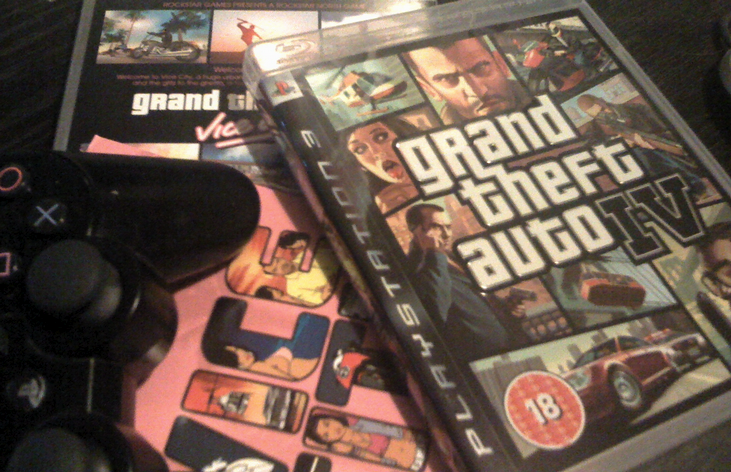
In the Grand Theft Auto video game, one of the many modes of transport is freely available in most parts of the game space - cars (obviously, if you are swimming around in the water then there are fewer cars, but...). Getting a car is very straight forward - you stand in front of a car, or approach one stopped at traffic lights, open the door and pull the driver out, then take their place and drive off. And so car-jacking just gets added to the list of crimes that you can carry out in this game ...

What's curious is that the ease of car-jacking in GTA seems to be spreading into the real world -well, at least, the unreal world of music videos. In the recent Robbie Williams 'Bodies' single release that starts off with a brilliant dance bass-line (via Trevor Horn, no less) and then goes in a different direction (balladic, no less), there's a scene where a woman with sunglasses turns up in a beach buggy (aka a dune buggy) and slows down to a stop, seemingly to offer the strolling Robbie a lift. In a striking piece of editing, one minute the woman is smiling at Robbie from the driver's seat, the next moment Robbie has vaulted in and is driving the beach buggy with the woman with sunglasses magically transported to the passenger seat. It happens so fast and so smoothly that I had to watch it again to make sure I was seeing things correctly. Magic!

(check your eyes here)

Now, I'm rather unfamiliar with the type of lift offering where the person you offer the lift to then drives the car, but it seems rather peculiar to me, especially when the woman continues to smile throughout as if giving your car to a perfect stranger was the most natural thing in the world. Of course, I'm sure that Robbie's PR people have a perfectly reasonable back-story that explains why this is totally explainable and not how it might appear, but then I'm sure that the Rockstar Games PR people have equally good explanations for the 'car-loan' scheme alternative that occurs in GTA as well.

It's a good thing that video games and music videos are not meant to accurately represent the real world, where people of both genders can drive cars without their major concern being the fear of someone arbitrarily taking over the task without warning. The truly remarkable thing is the title of the album from which the music video track is taken: Reality Killed the Video Star. In this case, the reality seems curiously lacking for one video star...

Reblog this post [with Zemanta]

Tuesday, 13 October 2009

Informed and critical

Surfing in Hawaii. A photograph of Kris Burmei...Image via Wikipedia

My kids continually amaze me with their internet-enabled awareness. A few recent instances of this show some interesting trends that affect how content providers should be thinking about making new content.

'It's like...'

My kids surf any available TV channels, looking for ones to watch (for about 5 seconds or less before flicking to another channel) AND ones to avoid (which are then studiously ignored forever, scorned and derided - you don't want to be on their 'tell everyone this channel is (insert current term of low esteem)' list). But their surfing is informed by their internet surfing - the internet is their source of pointers and critical thinking from their peers.

So 'How I met your Mother' is described as being 'Like 'Friends', but everyone is Ross'. Which is partly innate knowledge from years of watching repeats/reruns of Friends, and partly opinion from the internet: 'everyone says...'.

More surprising was the comment from my son about 'Being Erica', which is apparently 'like Quantum Leap'. Now this is more interesting because it is a late 80s / early 90s TV programme that hasn't been repeated/rerun in his lifetime... It turns out that my complete set of QL DVDs haven't gone unnoticed, but the internet acted as reinforcement.

So it may be no longer possible to recycle old media ideas and formats, secure in the knowledge that people will have forgotten the old version. My kids are very aware, and very scathing about re-use of ideas, unless, as with 'Being Erica' there is sufficient effort visibly expended in building on the old idea. So 'Heroes' was abandoned by my kids when they realised that once you have people who can do anything, anything can happen, and there's no consistency of storyline, explanations can be overturned, etc. Superhero stories work because of the limitations of the characters, not their powers, and with infinite possibilities comes infinite boredom and lack of motiviation to stay interested.

Finally, there's big categorisations - like 'Jennifer Aniston Movies', which I didn't think of as a genre, but which is increasingly mentioned in the same breath as 'What have they done since Friends?'. A youth that is connected and informed, and critical - maybe there is hope for humankind!


Reblog this post [with Zemanta]

Wednesday, 30 September 2009

Back from the Future?

On the 17th of September, my son came in from an evening appointment all flustered.


"We've just seen a DeLorean!" he exclaimed.

Apparently he had been in a car with some mates on the way home, and going around a roundabout a car had pulled onto the roundabout ahead of them from the left. One of them noticed that it looked unusual, and my son got his iPhone out. They didn't get very close, and had to turn off at the next roundabout, but my son did get some shaky pictures of what seems to be a DeLorean DMC-12 sports car...

Trying to take photos in a car which is attempting to catch up with an albeit legendarily allegedly slow sports car is never easy, and the photos go some way to proving this!

Of course, if this was CSI-world, then we would be able to digitally 'enhance' the photos, get the numberplate, see the driver's face, extract a 3D model, notice that the front left tyre was slightly deflated, etc. Unfortunately...


Reblog this post [with Zemanta]

Tuesday, 15 September 2009

Format for Television


I have had an idea for a new television programme format: 'Have Your Say'. It is based on something which has intrigued me for some time, and I've now realised that it would make a great format for television, so I'm giving it away for free.

The thing that has always intrigued me are the sometimes curious, sometimes inexplicable, and sometimes intriguing decisions that are made by people who have ultimate control over what happens in television programmes. Recent examples could include:

-Why did season 3 of Primeval start out with its main character, but lose him and his love interest by half-way through the season, and then introduce a replacement who behaved in much the same way?

-Why was Arlene Phillips replaced on the judging panel of 'Strictly Come Dancing'?

-Why did the Doctor Who publicity machine set up Martha Jones as the next Companion, only to lose her rapidly, and then quickly introduce a different new Companion?

-Why didn't Derren Brown actually explain how he did the Lottery prediction, on the subsequent 'How it was Done' programme?

(I'm sure you have your own questions!)

As you can imagine, there are lots of these types of questions, and whilst TV is full of investigative programmes about customer service, politics, crime, and the paranormal, TV itself is rarely held up to account for itself.

The format goes like this: Program researchers locate and investigate anomalous activity in TV decision making. Reporter presents results and identifies those responsible, who are invited to explain. Public then votes on which explanation they believe.

There's a lot to recommend this format. It uses skills that already exist (investigative reporting), there is no travelling required because the stories are all from the same place that the programmes themselves are made, the public voting will bring in much-needed cash, and the public gets to hear some interesting, amusing and maybe even plausible explanations - plus the public gets a chance to 'have their say' on how acceptable the explanations are!

Finally, some people might be already thinking of another format that already has broad television coverage, plus a voting scheme, but it only happens every few years: Politics.


Reblog this post [with Zemanta]

Sunday, 13 September 2009

Acceptance speech


Every so often, someone says something that indicates that a revolution has happened. Often, the person who says it does not realise the true significance of their words. It happened recently in the Radio Times, a venerable television (and radio!) listings magazine in the UK, and probably one of the oldest such magazines in the world.

In a interview, Julia McKenzie, the latest actress to fill the role of Agatha' Cristie's 'Miss Marple' on the small screen in the UK, said that people would have to get used to her replacing any previous holders of the role. Now I have no problems with the quote, nor Julia McKenzie, and there are people who have called this arrogance, but I'm not one of them.

Instead, I think that it is a remarkable statement that completely misses the point, and in doing so, it reveals some fascinating things about what is happening to television. Why do I think this? Here's why:

Julia's statement says that people have to accept that she is going to be the Miss Marple that they will see on their televisions, but neither is actually true. There is now nothing to stop people watching any of the previous Miss Marples, and so the Miss Marple that appears on televisions could be any one of them - via repeats on terrestrial channels, DVDs, satellite/cable channels that re-run programmes, internet players like the BBC's runaway success: iPlayer, etc. So Julia may not be the Miss Marple that people see, nor do people have to accept her in that role. People now have a choice, and her statement clearly indicates that she thinks they do not. Now this did indeed used to be the case: before video recording became a commodity, and before digital hard disk recording of TV (PVRs, TiVo, Sky Plus, etc), and before the internet, then you watched broadcast television, or you didn't - just two choices.

But things are not like that anymore. There are many ways to watch television, and all of them give people choice where they used to have none. And rather like giving people access to personal transportation devices like cars/automobiles, taking them away isn't going to be easy. The freedom that people now have to watch what they want, when they want to, is going to be very difficult to take away. But there's more to it than that.

People are now used to flexibility in watching television in some ways, but there are other flexibilities that are yet to come. The next digital revolution involves what happens inside a television programme, instead of what happens around it. The coming generation of television will enable us to change what happens inside a programme, what we want to happen, when we want it to happen. Miss Marple will never be the same again!


Reblog this post [with Zemanta]